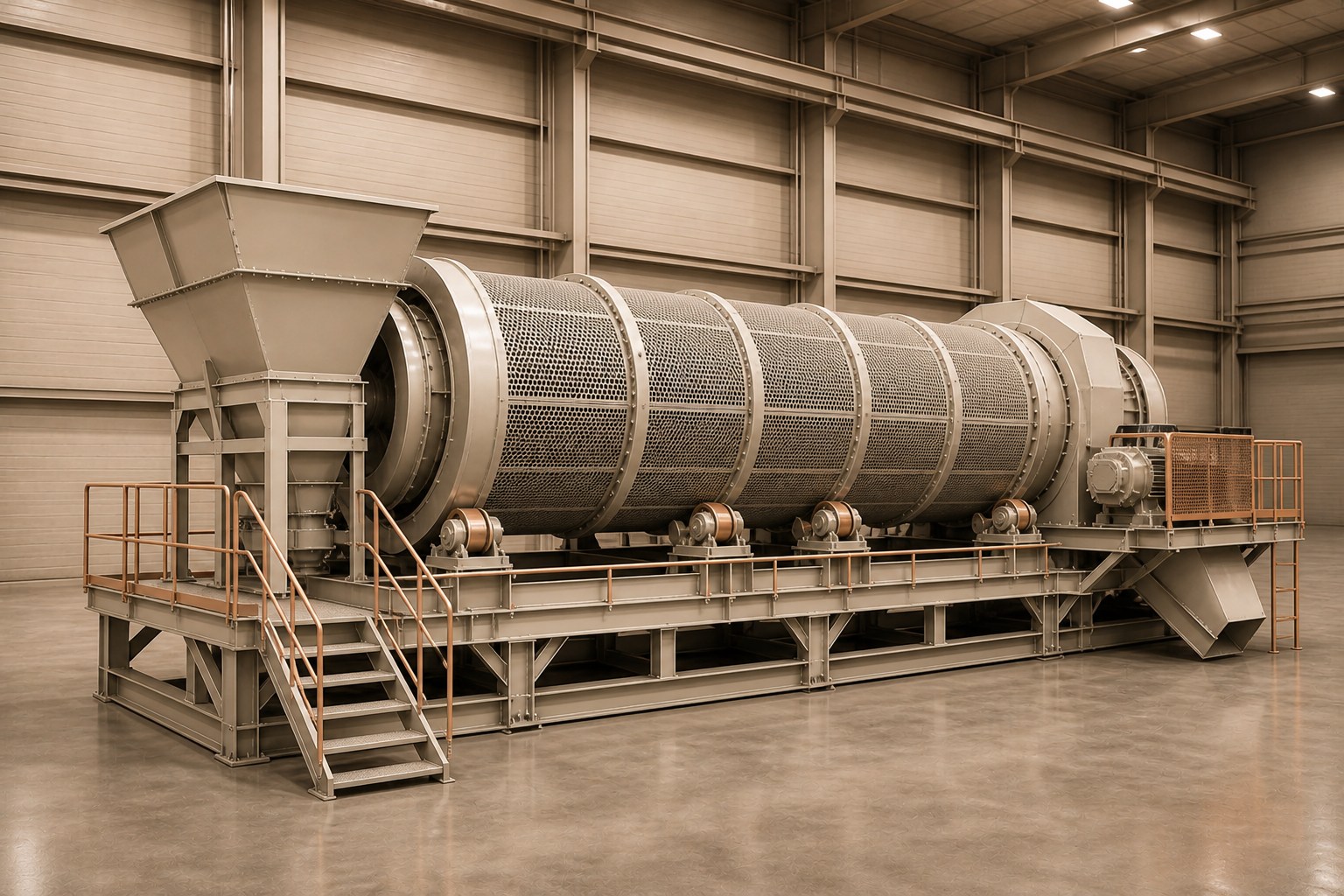
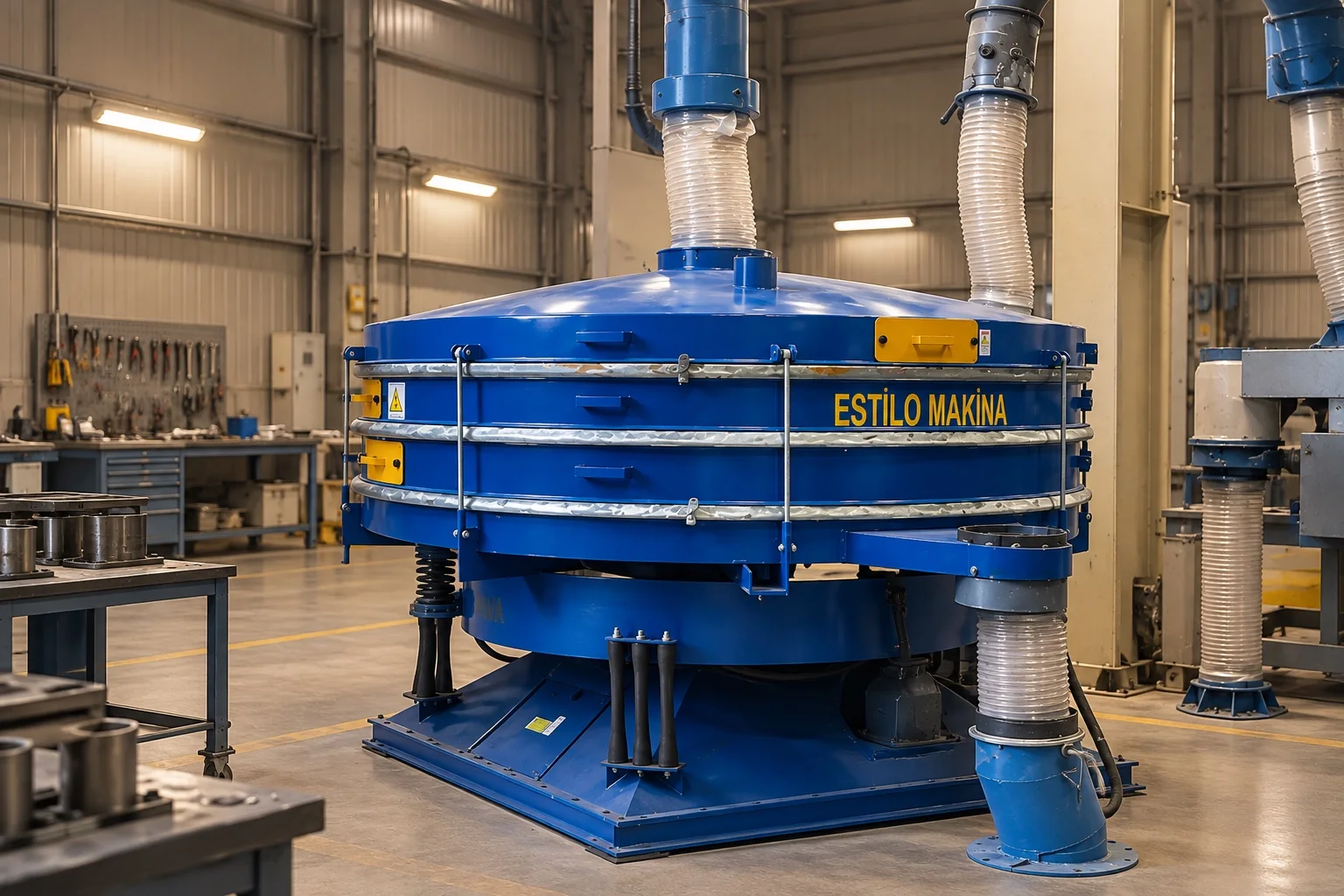
Screen selection combines material properties, feed rate and particle-size distribution, target separation size, nominal aperture, moisture, stickiness, required fractions and process interfaces.
What is nominal screen aperture?
Nominal aperture is the defined physical opening in the screening surface. Passage probability depends not only on particle size but also on shape, orientation, residence on the surface and the feed bed.
Aperture is therefore a primary design input, not a stand-alone guarantee of the actual product distribution or cut point.
Aperture, D50 and separator cut size
| Term | What it describes | What it does not describe |
|---|---|---|
| Nominal screen aperture | Physical opening in a screening surface | The complete separation curve by itself |
| D50 / D90 / D97 | Cumulative particle-size distribution of a sample | The physical screen opening |
| Separator cut size / d50c | Classification behaviour in an air separator | Mechanical screen aperture |
Use of the same length unit does not make these terms interchangeable.
Process inputs for selection
| Input | Why it matters |
|---|---|
| Material and bulk density | Influences surface loading, transport and equipment sizing |
| Feed rate | Influences required effective surface and feed arrangement |
| Feed particle-size distribution | Identifies passing, retained and near-size populations |
| Target separation size | Guides aperture choice and validation |
| Moisture and stickiness | Influence agglomeration, blinding and flow |
| Number of fractions | Influences decks, outlets and collection arrangement |
Open area and surface selection
Open area is the portion of a surface available for particle passage. A greater open area can increase passage opportunity, but wire or panel strength, wear, aperture stability, cleaning and duty must be considered together.
Open area is not a complete performance metric. When the surface is overloaded or material does not flow freely, theoretical passage area cannot be used effectively.
Moisture, stickiness and agglomeration
Moisture in fine material can increase cohesion and adhesion, covering apertures and causing surface blinding. The result can be a reduction in actual separation performance.
Feed conditioning, drying, surface type, feed distribution and cleaning are evaluated in the process. No universal moisture limit is stated; material testing is required.
How is selection verified?
- Use a representative sample and reliable feed PSD
- Evaluate moisture and agglomeration under realistic conditions
- Define product targets and acceptance criteria
- Design feed distribution and every fraction outlet together
- Use pilot or laboratory screening where appropriate
- Check maintenance, cleaning and surface replacement in the layout
Throughput, screen area, frequency, amplitude and efficiency require verified material- and equipment-specific engineering.