
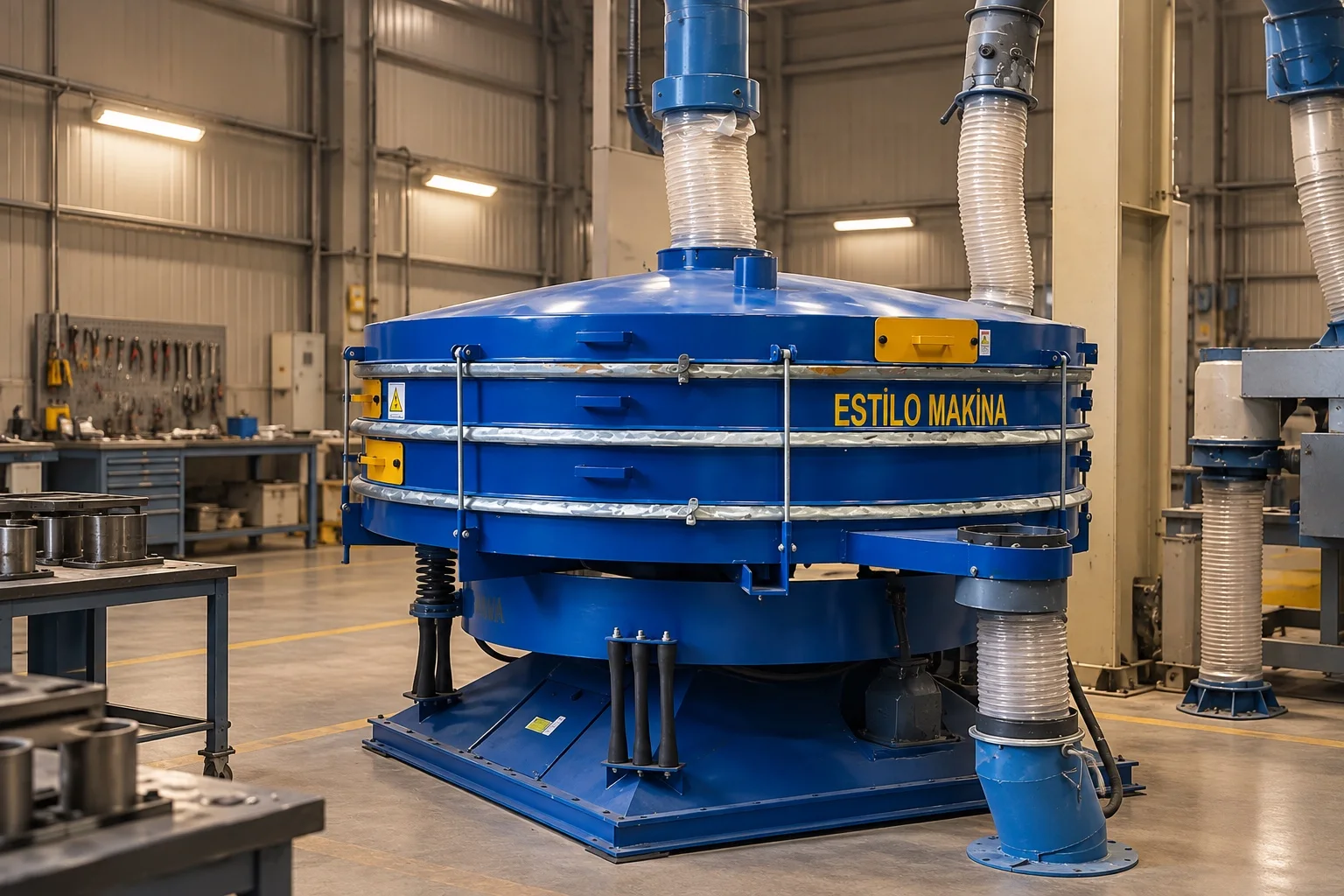
Circular vibrating screen concept for mineral-powder screening

Screening · Process equipment engineering

Circular Vibrating Screen
Engineered for the process.

Estilo circular vibrating screens are configured for screening and fraction control in mineral powders and micronized products. Review diameter, aperture and deck options, and request a quotation for your feed conditions.

Technical data

Technical range

Capacity may vary with material properties, feed particle size, moisture, screen aperture and deck count. Sizes above 2,600 mm may be evaluated through project-specific engineering.
ModelScreen diameter (mm)Screening area (m²)Deck countMotor power (kW)Capacity (t/h)
EST-DE-6006000.291–50.25Project-specific
EST-DE-100010000.711–51.5Project-specific
EST-DE-120012001.101–52.2Project-specific
EST-DE-160015801.801–5425–75
EST-DE-200018802.601–5440–100
EST-DE-240024003.631–55.5Project-specific
EST-DE-260025805.301–55.550–150

Equipment and circuit scope

Circular screen selection and product fractions

Evaluate Estilo circular screen diameter, aperture and deck arrangement against your product targets. Feed distribution, moisture and agglomeration behaviour guide mineral-powder screening selection. Review the technical table and include product outlets and line connections in your quotation scope.

  1. 01Controlled powder or mineral feeding
  2. 02Circular screening at selected apertures
  3. 03Separation of undersize, oversize and intermediate fractions
  4. 04Product collection and downstream transfer

Project quotation

Circular Vibrating Screen: quotation requirements

Share the following inputs so that equipment selection and the supply scope can be evaluated for your plant.

  • Material type and bulk density
  • Feed rate and particle distribution
  • Target aperture and number of fractions
  • Moisture, stickiness and agglomeration
  • Enclosure, dust control and transfer requirements
Request a project quotation
01

Intended use

Evaluated for dry mineral processes requiring post-grinding or post-drying product control, oversize removal and separation into defined fractions.

02

Working principle

The vibration drive moves material in a controlled pattern across a circular screen surface. Particles smaller than the nominal aperture pass through while oversize leaves through a separate outlet; the screen does not grind material.

03

Role in the process

A mechanical size-separation and product-control point between feeding and collection. Unlike an air separator, it separates through a physical screen aperture.

Engineering basis

Selection starts with process data.

Final capacity, motor power and dimensions are confirmed only after material and site inputs are evaluated.

Selection criteria

Material type and bulk densityFeed capacity and particle-size distributionTarget separation size and nominal apertureMoisture and stickinessRequired number of fractionsUpstream and downstream process connections

Construction and subsystems

  • Circular screen body and replaceable screen surface
  • Vibration drive and isolation elements
  • Feed, undersize and oversize outlets
  • Support frame and maintenance access

Options and configurations

  • Process-selected screen apertures
  • Single- or multiple-fraction arrangement
  • Enclosed body and dust-control connections
  • Integration with feeding and product transfer

Typical applications

  • Micronized mineral powders
  • Post-grinding product control
  • Agglomerate and oversize removal from dry fine materials
  • Separation into product fractions

Before requesting a quotation

Equipment selection questions

How is the number of screen decks selected?

Required product fractions and separation sizes define the deck arrangement. Feed distribution, moisture and screening load are assessed together with aperture and screen-surface selection.

Does the listed capacity apply to every mineral?

Capacity depends on material properties, particle distribution, moisture, aperture and deck count. Published ranges support preliminary selection; the operating point for your process must be verified separately.

Technical request

Share your material and capacity target.

Start request