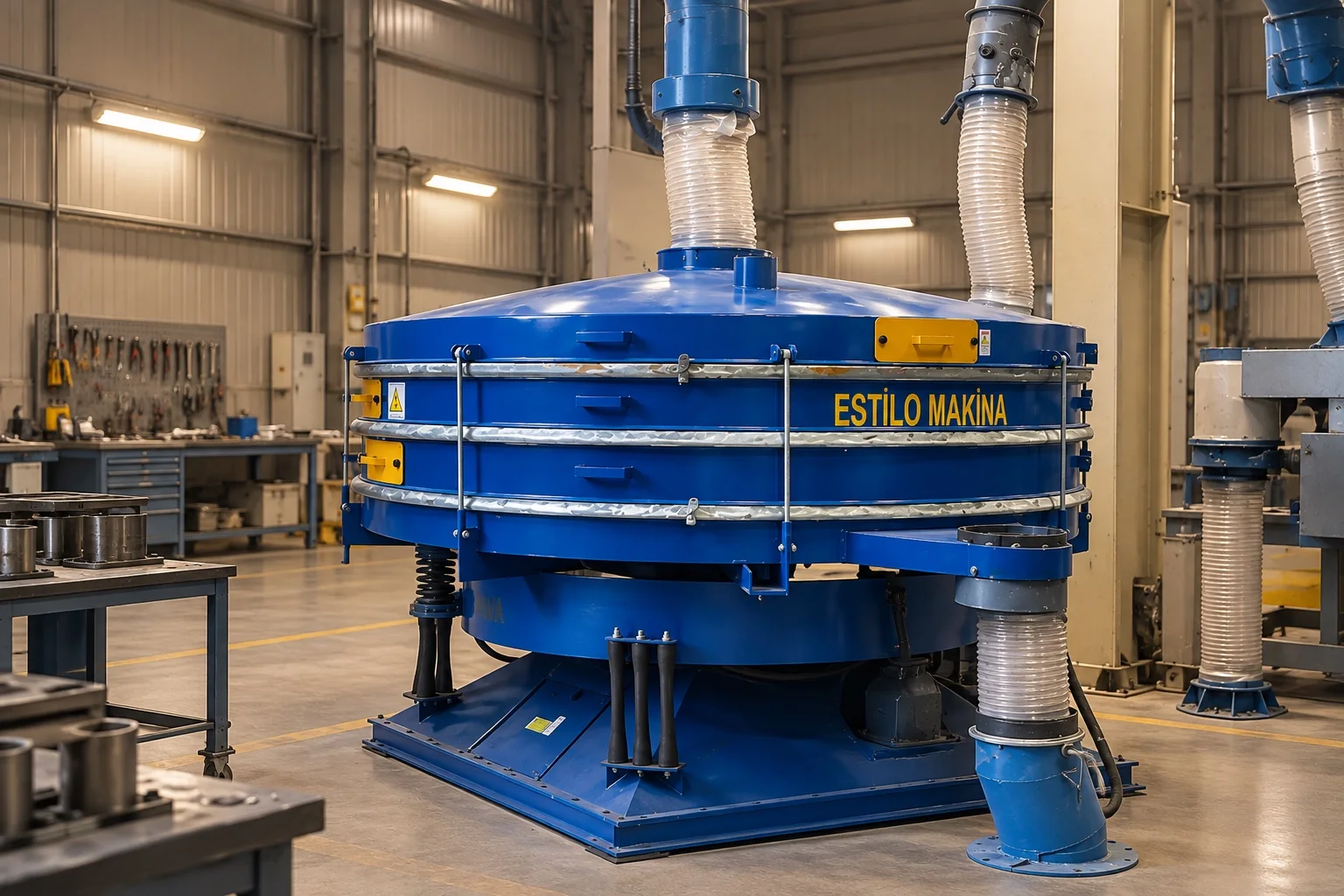
A circular vibrating screen moves material across one or more circular screen surfaces under controlled vibration. Particles that pass the aperture form the undersize fraction; particles retained on the surface form the oversize fraction.
Circular vibrating screen working principle
The vibration source transfers motion to the screen body and screening surface. Feed spreads across the surface; particles able to pass the selected aperture report to undersize, while larger particles advance toward the oversize outlet.
Actual separation is not determined by nominal aperture alone. Feed distribution, particle shape, surface loading, moisture, agglomeration and contact time all influence the result.
Material motion
Circular or compound vibratory motion promotes distribution and repeated presentation of particles to the apertures. The motion must be validated for the product and duty.
Screening surface
Aperture form, surface material and open area influence passage probability, wear, blockage and cleanability.
Decks and fraction separation
One screening surface produces two primary streams: undersize passing the aperture and oversize retained on the surface. Multiple decks can use successive apertures to produce several fractions.
Deck count and apertures are selected from the product target and test evidence; no unverified fixed deck count is stated for Estilo equipment.
Role in micronized mineral processing
A circular screener can be evaluated for post-grinding product control, removal of unwanted oversize or soft agglomerates, and division of dry mineral powders into fractions.
Calcite, kaolin, talc, quartz and gypsum powders are possible application examples. Suitability depends on size distribution, moisture, agglomeration, abrasiveness and cleanliness requirements; these examples are not Estilo project claims.
Fine dry product
Surface loading, moisture and cohesion become increasingly important with fine particles. Selection cannot rely on nominal aperture without confirming flow behaviour.
How it differs from other equipment
| Equipment | Separation mechanism | Primary distinction |
|---|---|---|
| Circular vibrating screen | Mechanical screening on an aperture-defined surface | Passed and retained fractions |
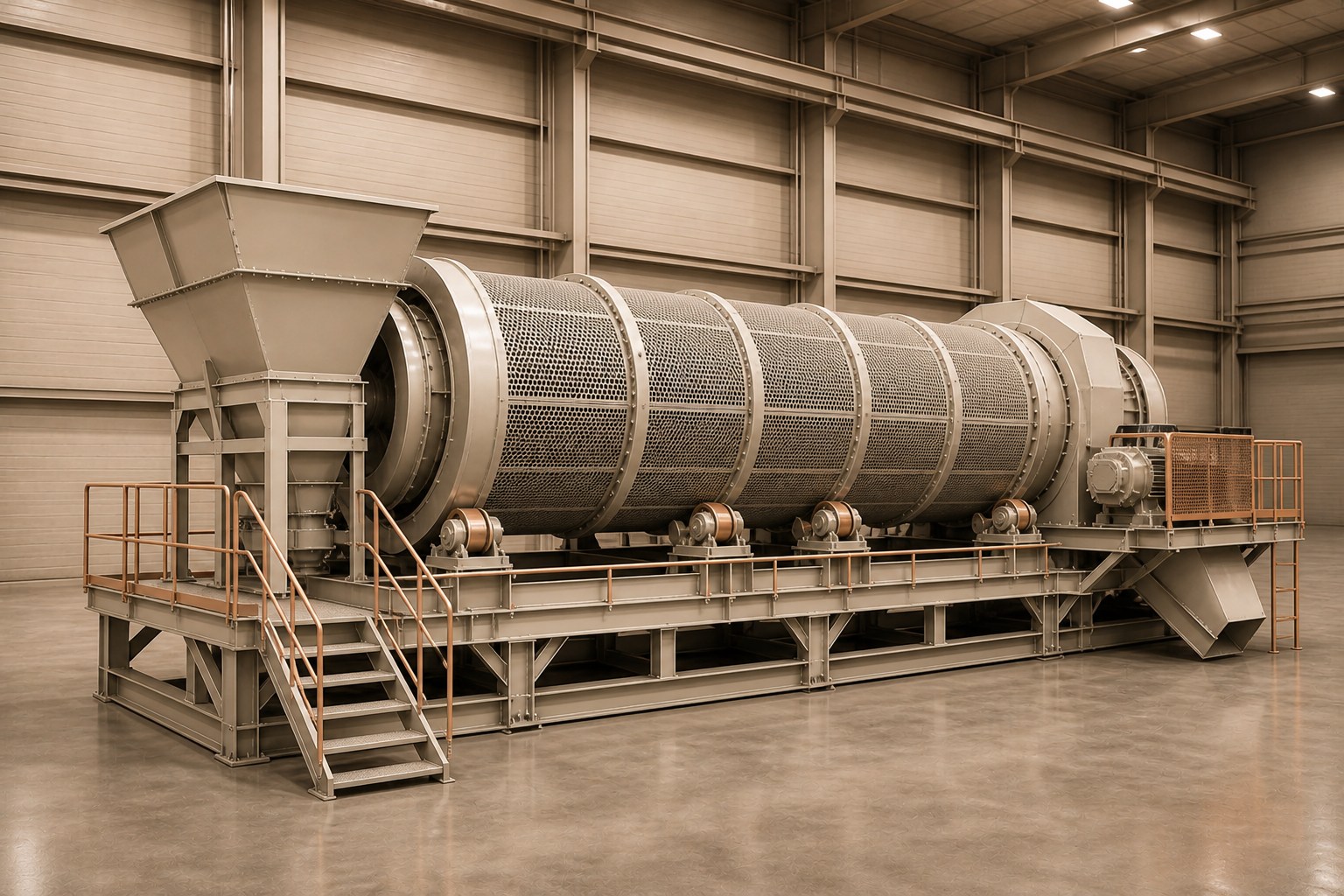
| Trommel screen | Mechanical screening in a rotating cylindrical surface | Continuous separation along the drum |
| Dynamic separator | Airflow and rotor classification | Fine/coarse split based on aerodynamic behaviour |
A circular screen does not grind material; it mechanically checks the distribution produced by grinding. Screen aperture is not synonymous with separator cut size or D50.
Engineering selection inputs
- Material, particle shape and abrasiveness
- Feed rate and particle-size distribution
- Target separation size and nominal aperture
- Moisture, stickiness and agglomeration tendency
- Required number of fractions
- Feeding, collection and dust-control arrangement
- Cleaning, access and maintenance conditions
Process integration
A circular vibratory screener is evaluated with the mill, dryer, separator, bin, transfer equipment and product-collection system. Feed distribution, routing of every fraction and dust control form part of the equipment selection.