
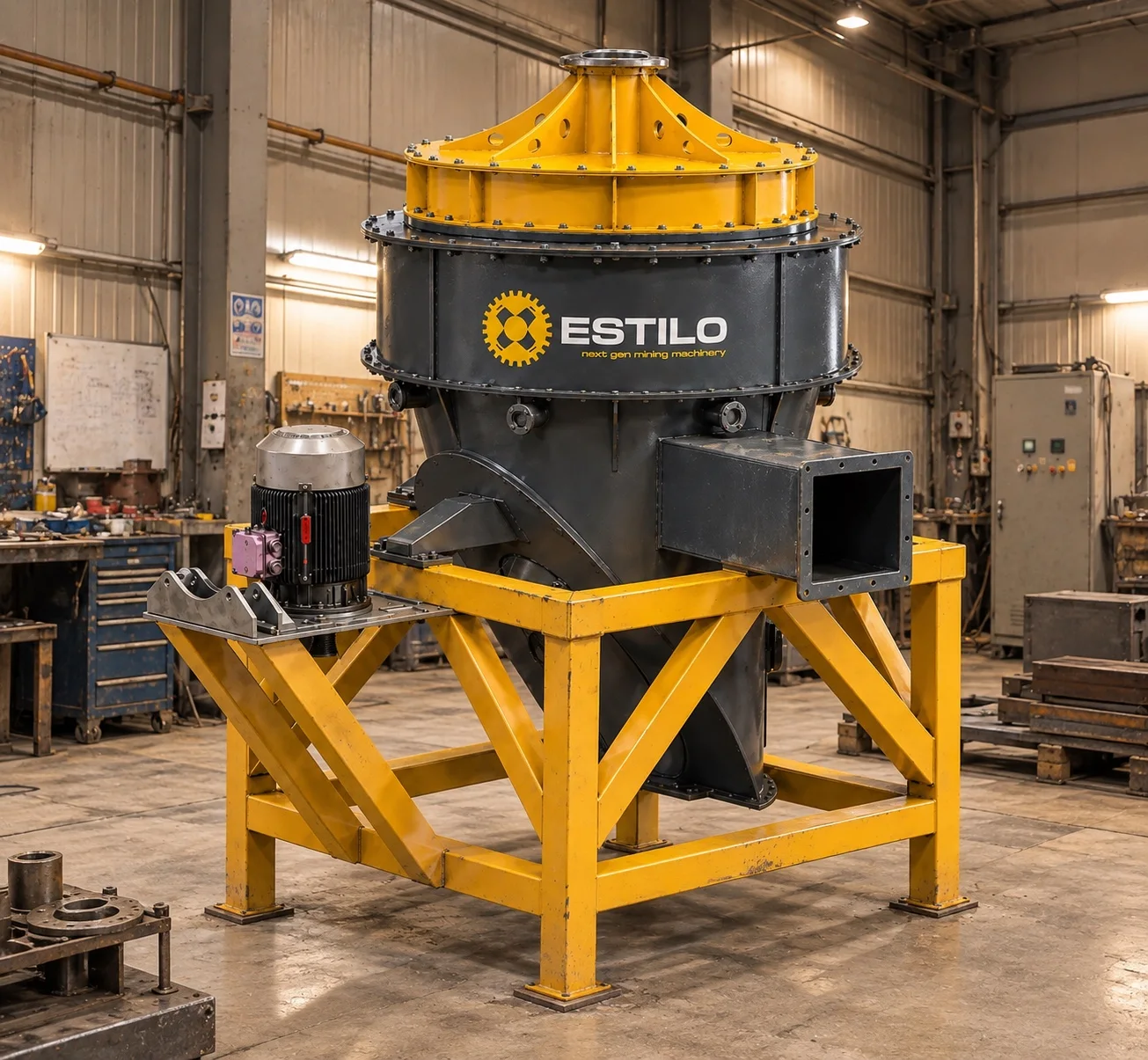
A dynamic separator uses airflow and the effect of a rotating classifier rotor to direct fine material toward the product stream while rejecting coarser material for return or another process path.
What is a dynamic separator?
A dynamic separator is an air classifier that separates dry particles in a flow field created by conveying air and a rotating classifier rotor. Its duty is to divide the fine fraction accepted to the product stream from the rejected coarse fraction.
Static and dynamic classification
Static classification relies on fixed flow passages and geometry. In a dynamic separator, the rotating rotor is an active part of the classification zone, so operating conditions and separation sharpness must be evaluated with the rotor–air system.
Airflow and particle motion
Feed must first be dispersed and then distributed uniformly into the classification zone. Air drag carries particles toward the product path, while inertia, density, shape and the rotating flow produce different trajectories.
Why does dispersion matter?
Agglomerated or uneven feed can make particles of similar size behave differently and create misplaced material. Moisture and stickiness are therefore classification inputs, not only feeding concerns.
Rotor and classification zone
Radial and tangential velocity components around the rotor interact with airflow and particle behaviour to create the cut region. Rotor speed cannot be interpreted independently of machine geometry, air volume, solids loading and material properties.
Why is there no universal rpm rule?
A test may show a relationship between rotor speed and product fineness under its own conditions, but that result cannot be transferred directly to another rotor, material or air system. Settings require sample and circuit validation.
How are fines and coarse particles separated?
Particles passing the classification zone travel with the fine-product stream. Rejected coarse material leaves through another outlet or returns to grinding in a closed circuit. Real separation is not an ideal knife cut; particles around the boundary size can report to either stream.
Cut size and separation sharpness
Cut size identifies a characteristic separation point, while separation sharpness describes how narrow or broad the transition is. One micron value does not describe complete performance.
A separator is not a screen
| Criterion | Dynamic air separator | Mechanical screen |
|---|---|---|
| Separation basis | Air–particle behaviour and rotating field | Geometric aperture |
| Process medium | Dry process air | Dry or wet mechanical feed |
| Boundary behaviour | Distributed transition and partition curve | Aperture/shape and screening probability |
| Main sensitivities | Air, rotor, load, density, shape and moisture | Aperture, blinding, bed depth and vibration |
Both devices can classify by size, but their physical principles and required selection data are different.
Duty in a grinding circuit
In a dry closed circuit, the separator removes the target product fraction and returns coarse material for further grinding. Product distribution, mill load and recycle flow are therefore controlled as one system.
Fine product and coarse return
Coarse material misplaced into fines can affect product specification, while fines misplaced into the coarse return can cause unnecessary regrinding. Both directions of misplacement require evaluation.
Core separator-selection inputs
| Input | Why it matters | Verification |
|---|---|---|
| Material and density | Influences particle motion | Representative sample and material data |
| Feed distribution | Defines load entering the separation zone | PSD and sampling plan |
| Target product distribution | Defines the accepted fine fraction | d-values and measurement method |
| Throughput and solids loading | Defines rotor and air-system duty | Mass balance |
| Moisture and stickiness | Defines dispersion/agglomeration risk | Feed condition and testing |
| Circuit type | Defines product and recycle streams | Flowsheet |
| Air and pressure loss | Influences transport and classification | Fan/duct/filter-system calculation |
Final rotor speed, airflow, capacity and cut size cannot be published without verified project data and supplier engineering.
