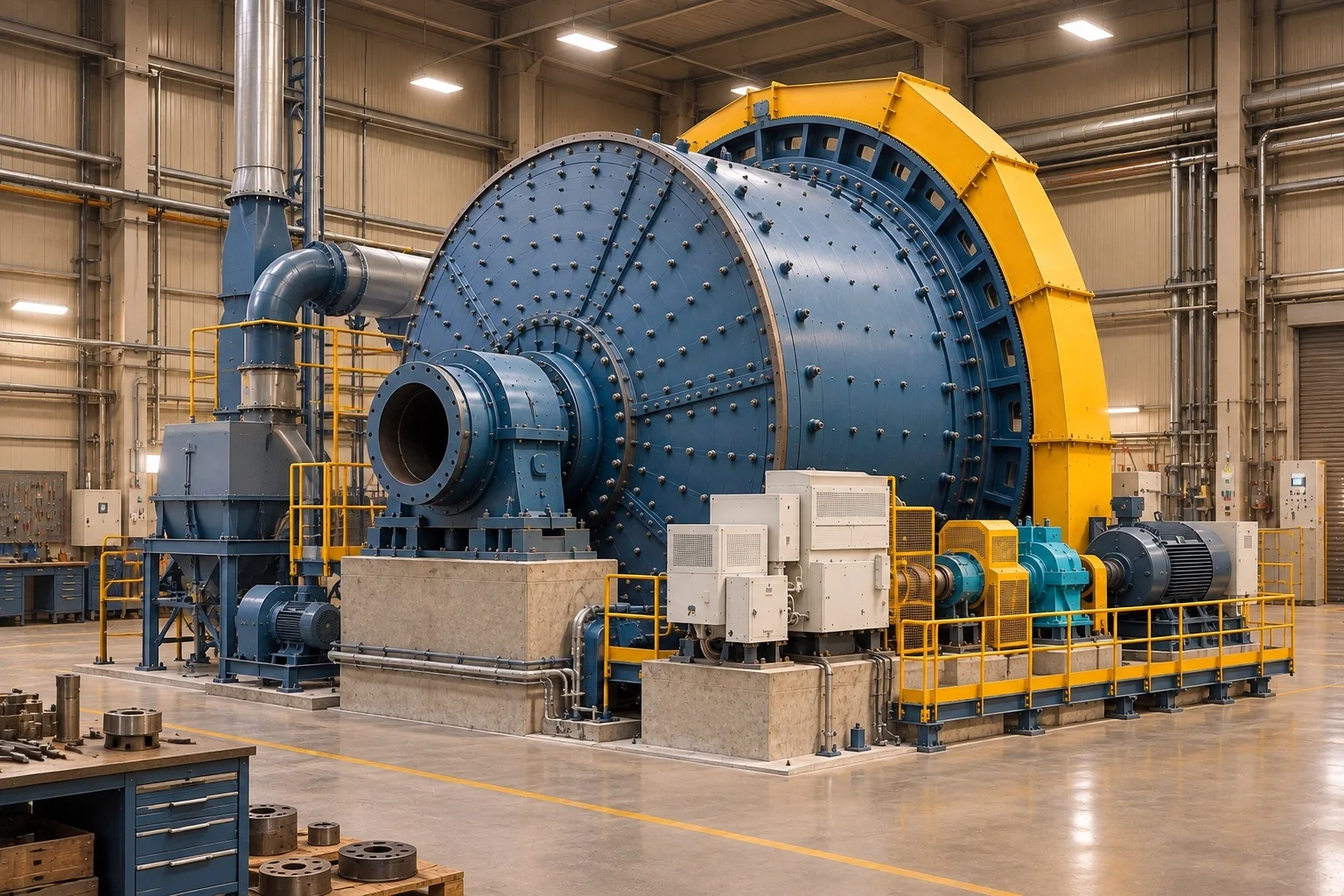
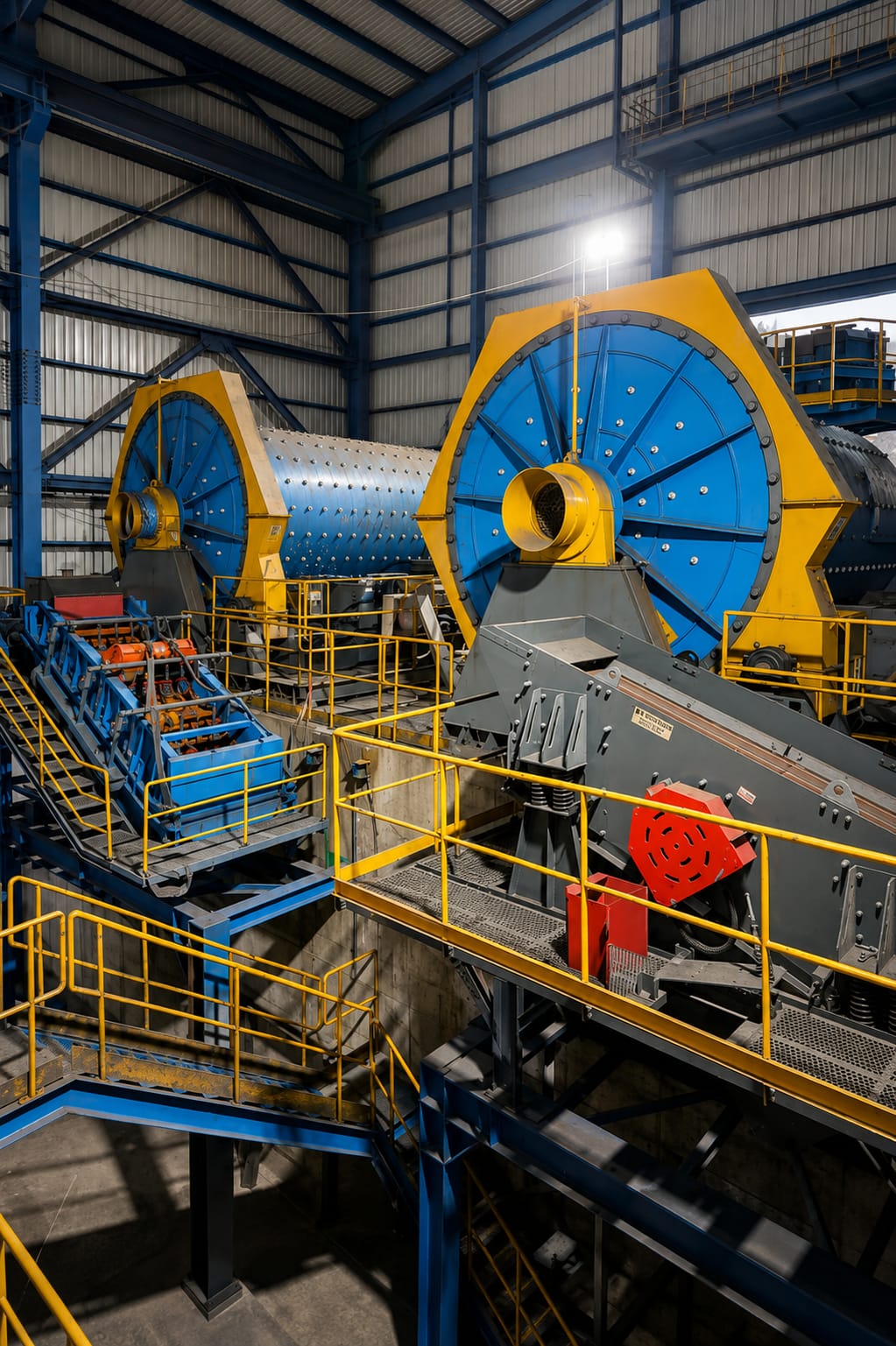
SAG-mill selection requires representative ore samples, SAG-specific breakage testwork, capacity and product targets, circuit configuration, critical-size management, downstream ball milling and maintenance strategy to be modelled together.
Sampling is the starting point of design
A SAG circuit is sensitive to the breakage and grinding-medium behaviour of coarse ore. A planned sample set representing hardness, competency, texture and feed variability is therefore required rather than one average sample.
If sample origin, preparation and represented production period are not recorded, the test result may not describe design risk correctly.
Engineering data matrix
| Decision area | Required basis | Design impact |
|---|---|---|
| Ore breakage behaviour | Impact/abrasion breakage and competency | Specific energy and shell duty |
| Feed | Distribution, F80 and coarse-fraction variability | Charge motion and circuit load |
| Product | Transfer size and final P80 | Downstream mill/classification duty |
| Capacity | Operating schedule and availability | Design throughput and redundancy approach |
| Circuit | Single stage, SAG–ball or pebble crushing | Equipment count and recycle streams |
| Mechanical system | Liners, discharge, drive and bearings | Energy transfer, maintenance and reliability |
| Site | Elevation, space, access and infrastructure | Layout, erection and operation |
Testwork and modelling
SAG-appropriate breakage and grindability tests establish the ore's impact/abrasion response and energy basis for the circuit model. Test selection is defined with a competent laboratory for the expected feed and flowsheet.
Pilot work or calibrated simulation can reduce selected risks, but model inputs are not reliable without representative samples and correct procedures.
Why is variability assessed separately?
An average result can hide a bottleneck during hard or competent ore periods. Design considers the expected variability range together with the operating strategy.
Circuit configuration
Single-stage SAG, SAG–ball or SAG–ball with pebble crushing are compared against product target, ore behaviour, capacity, energy and site constraints. SAB and SABC describe SAG–ball and SAG–ball–crusher relationships respectively; the names alone do not prove suitability.
Downstream ball mill
The ball mill takes the transfer product toward a finer target. SAG discharge distribution, classification and circulating load directly influence downstream sizing.
Classification and water balance
In a wet circuit, classification performance and water balance influence transport, recycle and final product. A dry-circuit concept requires separate validation of material and equipment approach.
Critical size and pebble management
Intermediate material that does not break effectively can accumulate in the SAG mill. Trommel/screen opening, pebble recycle, a crusher option and feed adjustment are evaluated through mass balance and test data.
Liners, discharge, drive and maintenance
- Evaluate liner/lifter profile with charge motion and wear
- Verify grate and pulp-lifter capacity against product transport
- Select the drive against starting, operating and site electrical conditions
- Include liner replacement, lifting equipment and safe access in layout
- Create a monitoring plan for wear, vibration, temperature and lubrication
- Connect spares and planned shutdown strategy with availability target
Final capacity, power, charge, speed and dimensions are established only through verified testwork, mass/energy balance and supplier engineering.