

All projects
Complete Plant
Kütahya Quartz Drying, Grinding and Classification Plant
An integrated quartz processing plant developed for Ant Porselen, combining drying, ball milling and dynamic classification with adjustable product fineness. The investment was planned as a five-line production system.
Project typeComplete Grinding PlantMaterialQuartzCustomerAnt PorselenLocationKütahya / TürkiyeStatus5-line projectCapacity≈7 t/h field operating pointProduct fineness≈1–100 µm adjustable product / classification operating rangeProcessDrying, Grinding, Classification and FiltrationFinal productDry fine quartz powder
Process summary
01 · Project need
What the project needed to achieve.
Ant Porselen planned a new investment to enter quartz grinding production. The project therefore required an integrated system for drying wet quartz, ball milling, dynamic classification and dry product collection. The process is operated with adjustable parameters rather than a single fixed product fineness.
PLANT OVERVIEW
The five-line investment was planned as one integrated process system.
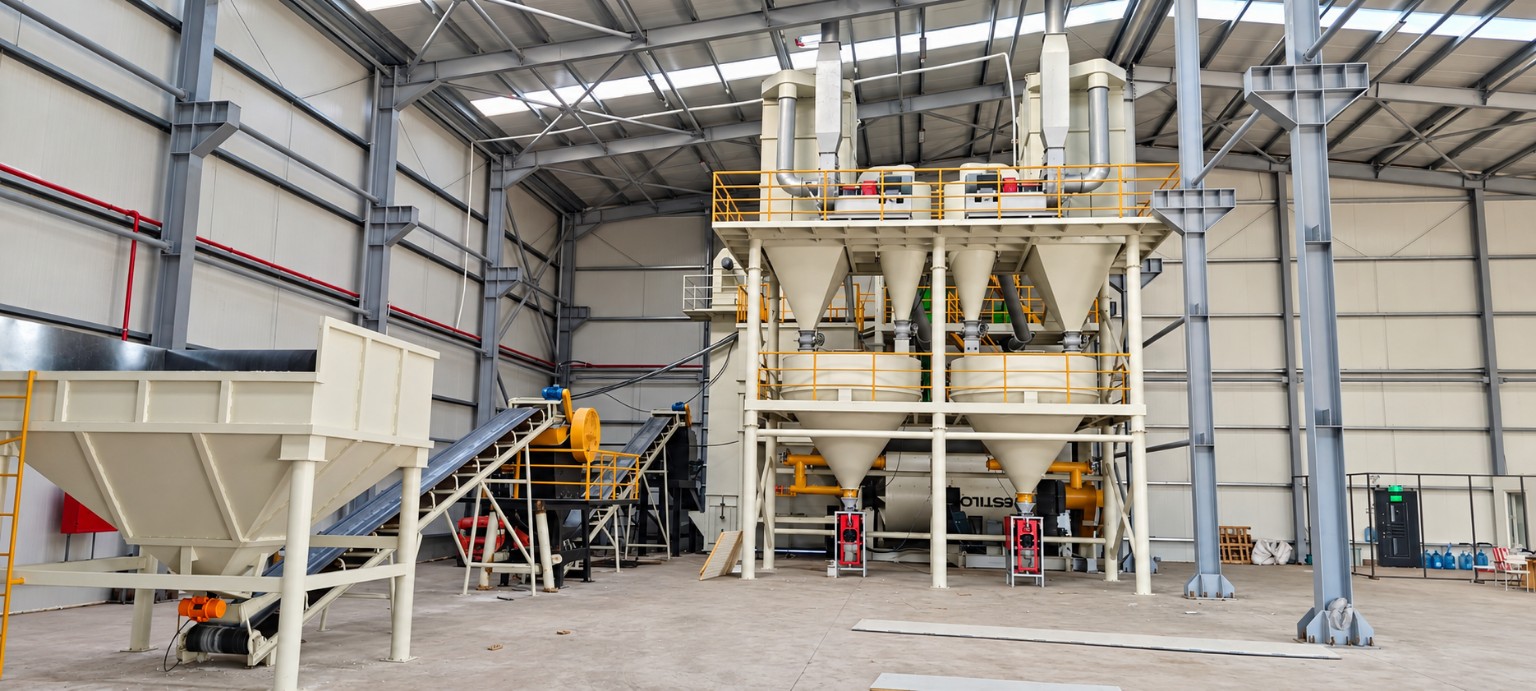
Ant Porselen's new quartz investment in Kütahya was planned as a total of five production lines. The layout integrates drying, conveying, grinding, classification and product collection into one process system.
General field view of the five-line quartz process plant investment for Ant Porselen in Kütahya · Real project field image02 · Process flow
A connected line, not isolated machines.
- 01
Wet Quartz
Moist raw material entering the plant.
- 02
Feed Bunker
Receives the raw material and transfers it steadily to drying.
- 03
Double-Shell Rotary Dryer
Reduces moisture using an inner and outer drum arrangement and prepares wet quartz for grinding.
- 04
Bucket Elevator
Lifts the dried material to the pre-mill bunker.
- 05
Pre-Mill Bunker
Buffers material and regulates feed to the mill.
- 06
Ball Mill
Uses ceramic grinding media to reduce dried quartz toward the required product fineness.
- 07
Bucket Elevator
Transfers ground material to classification.
- 08
ASB900 Dynamic Separator
Classifies ground quartz through the combined adjustment of rotor speed and process airflow.
- 09
Filter
Separates and collects the target fine product from process air.
- 10
Dry Fine Product
Collected final quartz powder.
03 · Documented project scope
Systems visible in the published record.
Documented Process Elements
- Drying–grinding–classification–filtration chain
- Elevator, screw-conveyor and bunker transfer connections
- Equipment layout and field integration
Visible Structure & Access
- Support structures
- Platforms and stairs
- Maintenance and equipment-access areas
Engineering context visible in the field record
Relationships supported jointly by the photographs and process record.
Material Flow
The published record shows the transfer points as one process chain from wet raw-material intake to dry-product collection.
Drying–Grinding Relationship
In the documented flow, quartz passes through the drying section before the grinding stage.
Buffering & Feed
The field images show the intermediate-storage and feed relationship among bunkers, elevators and the mill.
Grinding & Classification
The published process flow shows particle-size classification by separator after grinding.
Product Collection
Classification, filtration and dry-product transfer appear together in the final section of the documented line.
Field Layout
The photographs make equipment elevations, vertical conveying and support-structure relationships visible.
Maintenance & Access
Platforms, stairs and equipment-access areas are clearly visible in the field record.
Verified project information
Main technical facts.
- Customer
- Ant Porselen
- Location
- Kütahya, Türkiye
- Raw Material
- Wet quartz
- Project Scope
- 5 production lines
- Adjustable Operating Range
- ≈1–100 µm This value is not verified as a specific d50 or d97 percentile metric; process and classification settings are adjusted according to the target product condition.
- Observed Field Throughput
- ≈7 t/h Approximate value observed at a specific operating point; not a guaranteed capacity.
- Dryer
- Double-shell rotary dryer
- Separator
- ASB900 dynamic separator
- Dryer Feed Belt
- 13 Hz · 2.12 A Example field operating point.
- Dryer Drum
- 50 Hz · 5.85 A Example field operating point.
- Mill Feed Vibrator
- 40 Hz · 0.27 A Example field operating point.
- Separator
- 18 Hz · 12.5 A Example field operating point.
- Fan
- 60 Hz · 124 A Example field operating point.
- Mill
- 45 Hz · 248.5 A Example field operating point.
- Cyclone Inlet Airlock
- 80 Hz · 1.0 A Example field operating point.
- Temperature
- 130 °C set · 119 °C reading Values recorded at the same HMI operating point.
Real project evidence
What does the field record verify?
Three real field photographs document how feeding, vertical conveying, grinding, classification and collection equipment relate within the same plant layout. The photographs are not used as evidence of numerical performance or contractual responsibility.
- Two field operation lines commissioned within the five-line investment
- Integration of the double-shell rotary dryer, ball mill and ASB900 dynamic separator within the same process line
- Ceramic grinding media, final product discharge and raw-material-to-product comparison
- Example frequency, current and temperature values recorded from the Delta HMI
- Real workshop records from the separator manufacturing and assembly stages
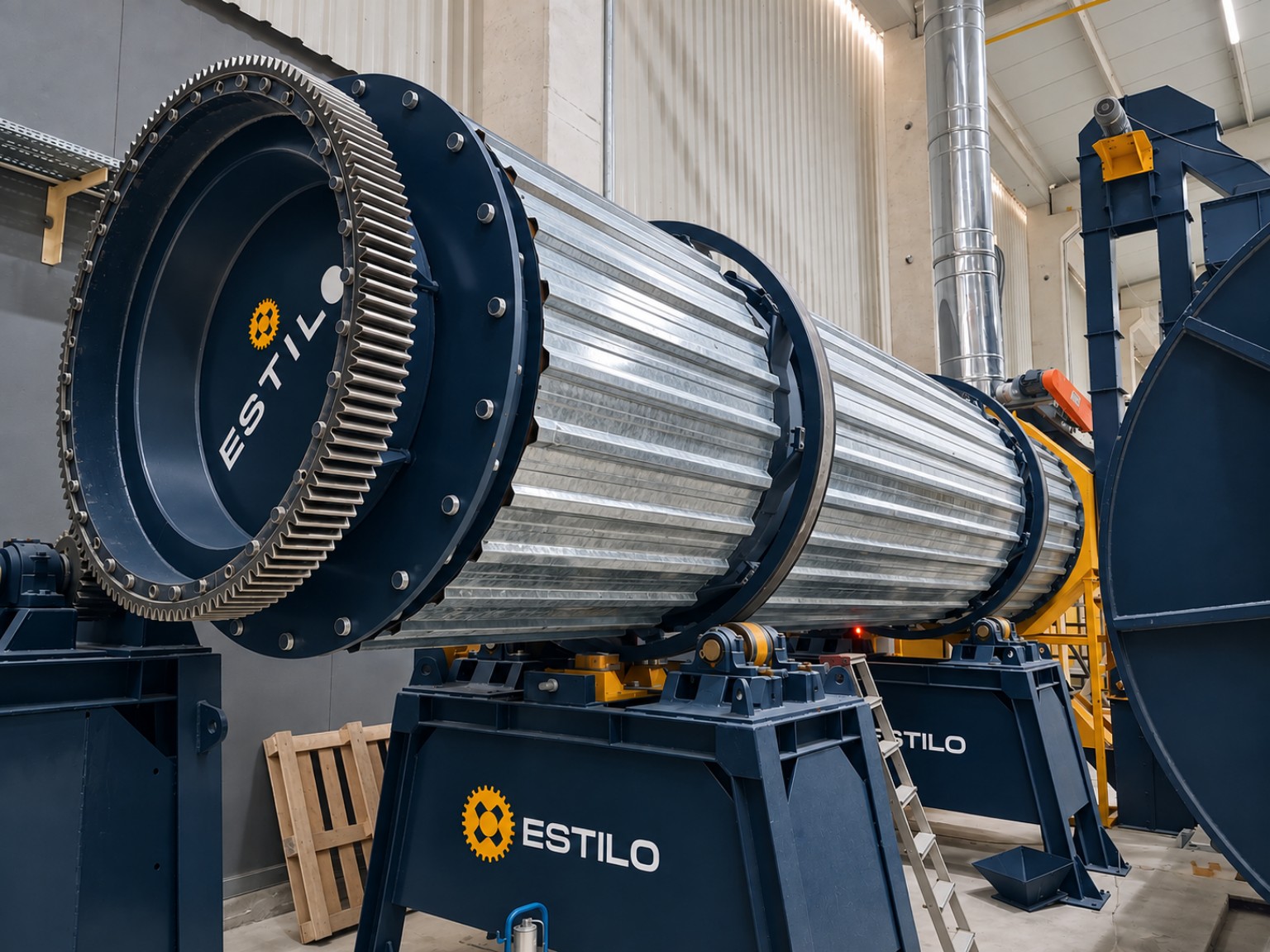
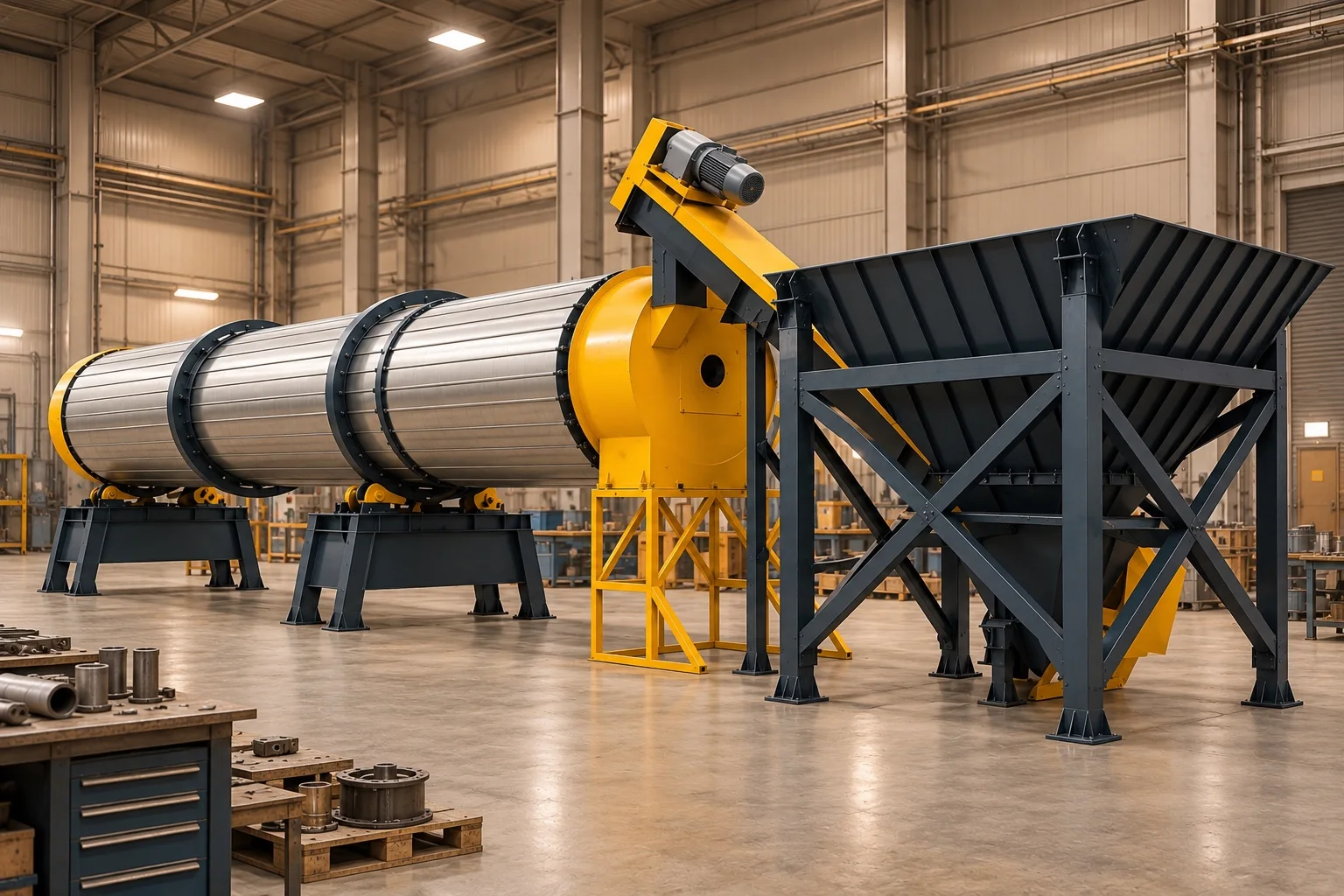
DOUBLE-SHELL DRYING
Wet quartz is dried under controlled conditions before grinding.
The dryer uses an inner and outer drum configuration. Its purpose is to reduce the moisture load of the raw material and create more stable feed conditions for the ball mill. Drying conditions are adjusted according to feed moisture and process requirements.
Double-shell rotary dryer used to prepare wet quartz before grinding · Real project field image
MECHANICAL DRIVE
The ball mill drive system is integrated into the field process.
Drum rotation is provided through the motor, gearbox and mechanical power-transmission system. At the recorded HMI operating point, the ball mill was running at 45 Hz and 248.5 A.
Field view of the ball mill motor, gearbox and mechanical power-transmission group · Real project field image
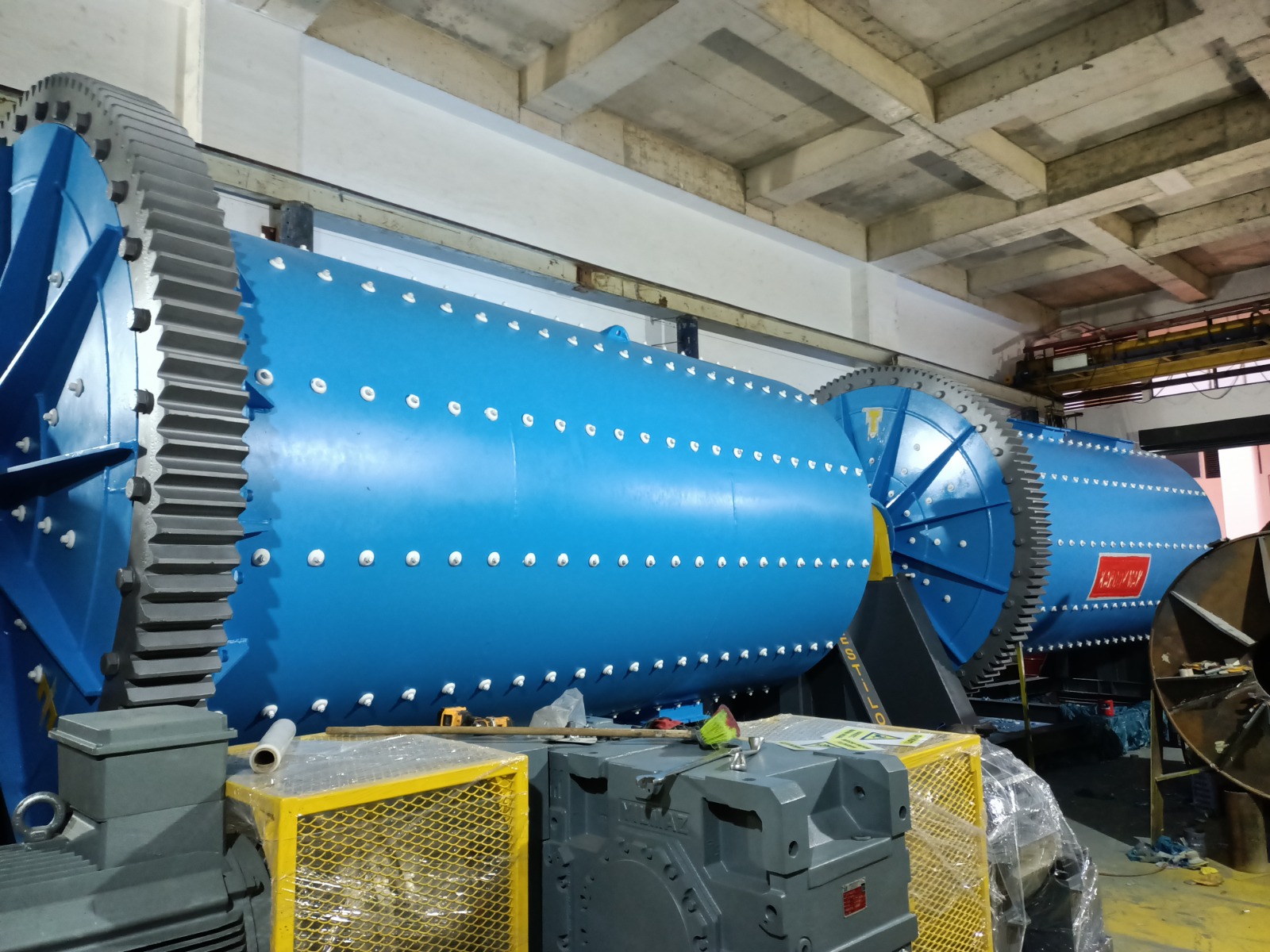
BALL MILLING
Quartz is finely ground using ceramic grinding media.
Ceramic grinding balls of different sizes are used inside the ball mill. Mill speed and feed rate are adjusted together according to the required product distribution. The image shows the actual grinding media used in the process.
Ceramic grinding media used for fine grinding of quartz · Real project field image
FIELD OPERATING POINT
The HMI records real operating parameters from the commissioned line.
At this operating point, the dryer feed belt was at 13 Hz, dryer drum 50 Hz, mill feed vibrator 40 Hz, separator 18 Hz, fan 60 Hz, mill 45 Hz and cyclone inlet airlock 80 Hz. The temperature setpoint was 130 °C with a 119 °C reading. These values represent one field operating point, not a fixed process recipe.
HMI speed, current and temperature values recorded at a specific operating point · Real project field image
RAW MATERIAL TO PRODUCT
The physical transformation of the quartz is visible in one frame.
Wet, darker raw quartz is visible on the right, while the lighter fine product after drying, grinding and classification is shown on the left. The product and classification operating point can be adjusted within an approximate 1–100 µm range through process settings; this range is not presented as a specific d50 or d97 percentile value.
Wet raw material on the right and the fine quartz product after drying and grinding on the left · Real project field image
FINAL PRODUCT COLLECTION
The fine quartz product is discharged to the big-bag filling point.
After dynamic classification and separation from process air, the target fine fraction is collected as dry product. The image shows the actual final product discharge and big-bag filling point.
Transfer of the final dry product to a big bag after classification and collection · Real project field image
PROCESS AIR
Airflow is one of the main control variables in dynamic classification.
Separator rotor speed and process airflow jointly influence classification. The recorded 60 Hz fan and 18 Hz separator values belong to one operating condition; settings are adjusted according to target fineness, feed conditions and material behaviour.
Process-air equipment used in dynamic classification and product conveying · Real project field image
SEPARATOR MANUFACTURING
The dynamic classification equipment is documented during workshop manufacturing.
The manufacturing and assembly stages of the separator body, support structure and mechanical components are documented with a real workshop image. The unit is used to separate fine and coarse fractions of the ground product.
Real manufacturing and assembly view of the dynamic separator in the workshop · Real project field image
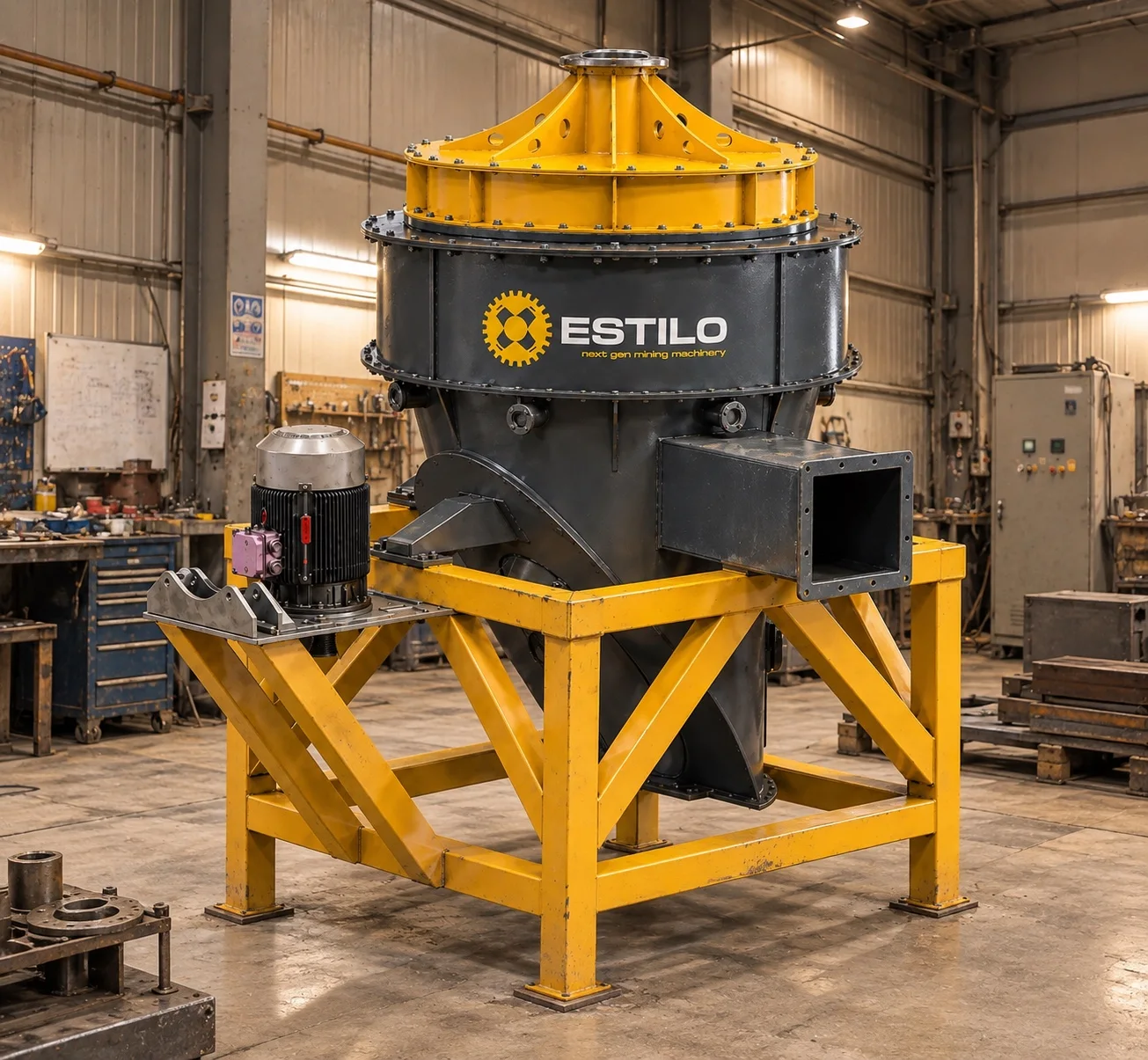
DYNAMIC CLASSIFICATION
The ASB900 separator is one of the key elements used to adjust product fineness.
The dynamic separator changes its classification behaviour through combined adjustment of rotor speed and process airflow. The system is therefore not tied to one fixed micron value; operating parameters are optimised according to the required product condition.
General view of the separator manufactured for the classification line · Real project field imageField-application evidence
The process and layout documented by the published record.
- 01
Integrated Process Line
Drying, grinding, classification and filtration sections are connected in the published flow.
- 02
Material Transfer
Bunker, elevator, screw-conveyor and mill interfaces are visible in the real field photographs.
- 03
Classification & Collection
The layout relationship among the separator, filter and dry-product transfer is documented.
- 04
Field Access
Platforms, stairs and support structures are visible in the real project images.
Project gallery
Real Images from the Site
Open any image full screen; zoom, pan or move between images.
Documented project scope
An integrated process record supported by real field images.
The investment was planned as a five-line quartz processing project in Kütahya. The first two lines have been commissioned and are documented in field operation. Field records document the integrated relationship between the double-shell rotary dryer, ball mill, ASB900 dynamic separator, process-air system and dry-product collection equipment.
Systems used in the project
Explore the related equipment.
Engineering insights
Read the engineering behind this process.
Technical noteHow Does a Quartz Grinding Plant Work?Technical noteMineral Processing Plant Flow and Equipment SelectionTechnical noteWhat Is a Rotary Dryer and What Determines Its Capacity?Technical noteHow Are Moisture and Drying Load Calculated?Technical noteBall Mill Capacity and SizingTechnical noteWhat Is a Ball Mill and How Does It Work?Technical noteOpen-Circuit vs Closed-Circuit GrindingTechnical noteWhat Is a Dynamic Separator and How Does It Work?Technical noteSeparator Selection and Cut SizeTechnical noteClassification Efficiency and Circulating Load
Related projects
Continue through the project archive.
Only field and process information suitable for technical reference is published.
PLANNING A SIMILAR MINERAL GRINDING PLANT?
Let us evaluate the process configuration using actual material and capacity data.
Share material type, initial moisture, feed size, target product fineness and capacity so we can review the appropriate process configuration together.