
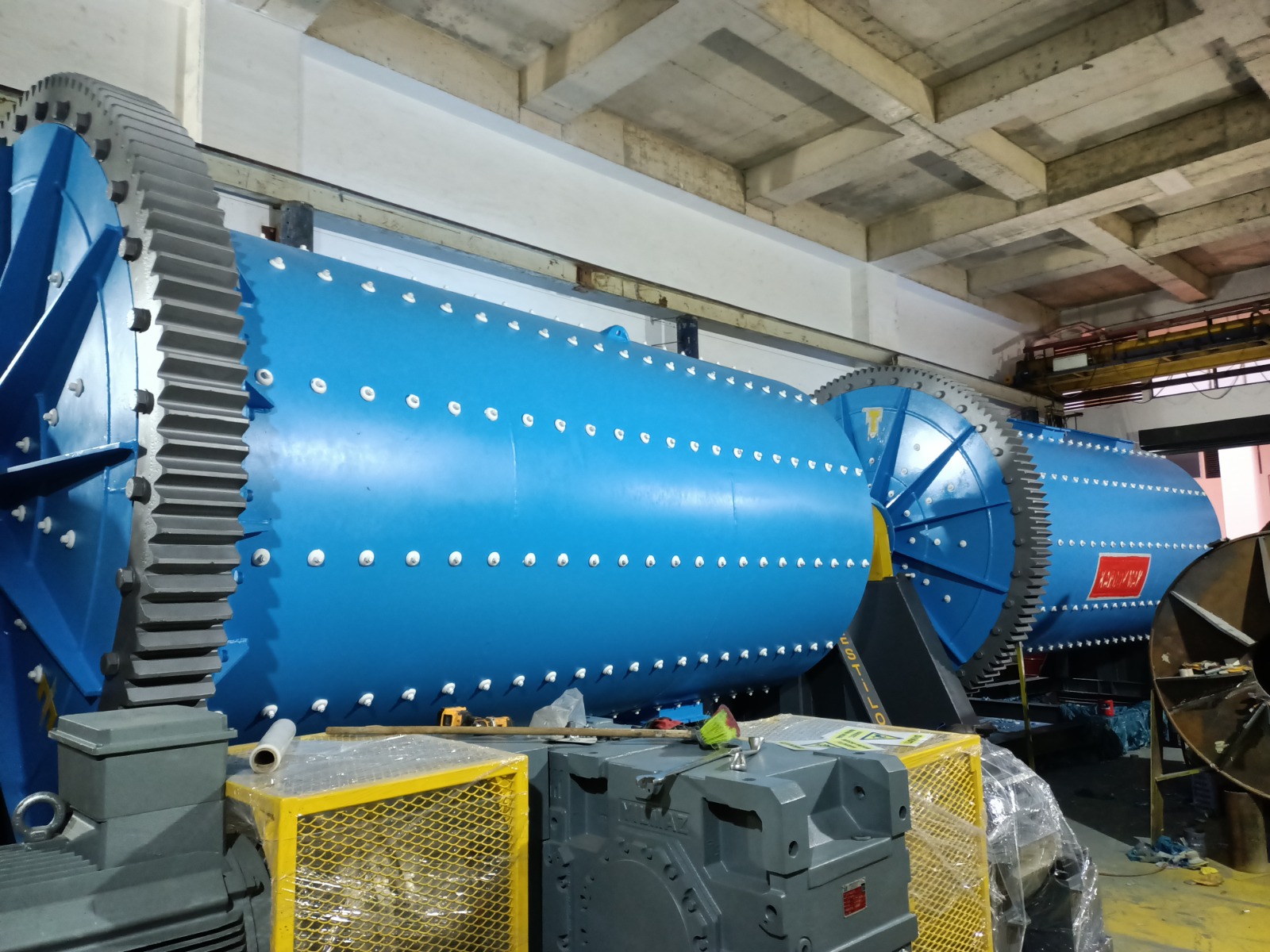
A ball mill is an industrial grinding machine that reduces particle size by using the impact and abrasion generated by grinding balls inside a rotating cylindrical shell.
Working principle
As the shell rotates, the grinding media and feed are lifted and then move through cascading, rolling and sliding motion. The resulting impact and abrasion break the material into smaller particles.
Grinding behaviour is not controlled by rotational speed alone. Shell geometry, media filling, liner profile, feed-size distribution, material characteristics and residence time interact with one another.
Main components
A general ball-mill system includes the rotating shell, internal liners, grinding media, feed and discharge arrangement, drive, bearings and associated auxiliaries. The actual configuration changes with the process duty.
Shell, liners and media
The shell carries the working volume; liners protect the shell and influence charge motion; the balls transfer mechanical energy to the material.
Drive, bearings and material interfaces
The drive supplies rotation, bearings support the rotating mass, and feed/discharge design influences material transport through the mill.
Dry and wet grinding
Ball mills can operate in dry or wet circuits depending on the process. The choice must be considered together with downstream classification, material handling, moisture conditions and the overall plant flowsheet.
Main selection inputs
- Feed size and size distribution
- Target product fineness and distribution
- Material grindability and abrasiveness
- Design capacity and operating schedule
- Dry or wet processing
- Open- or closed-circuit operation
- Site, maintenance and energy constraints
Role in the process
A ball mill is rarely evaluated in isolation. In closed circuits it works with a classifier or separator so that coarse material returns for further grinding while the target fraction leaves the circuit.
