
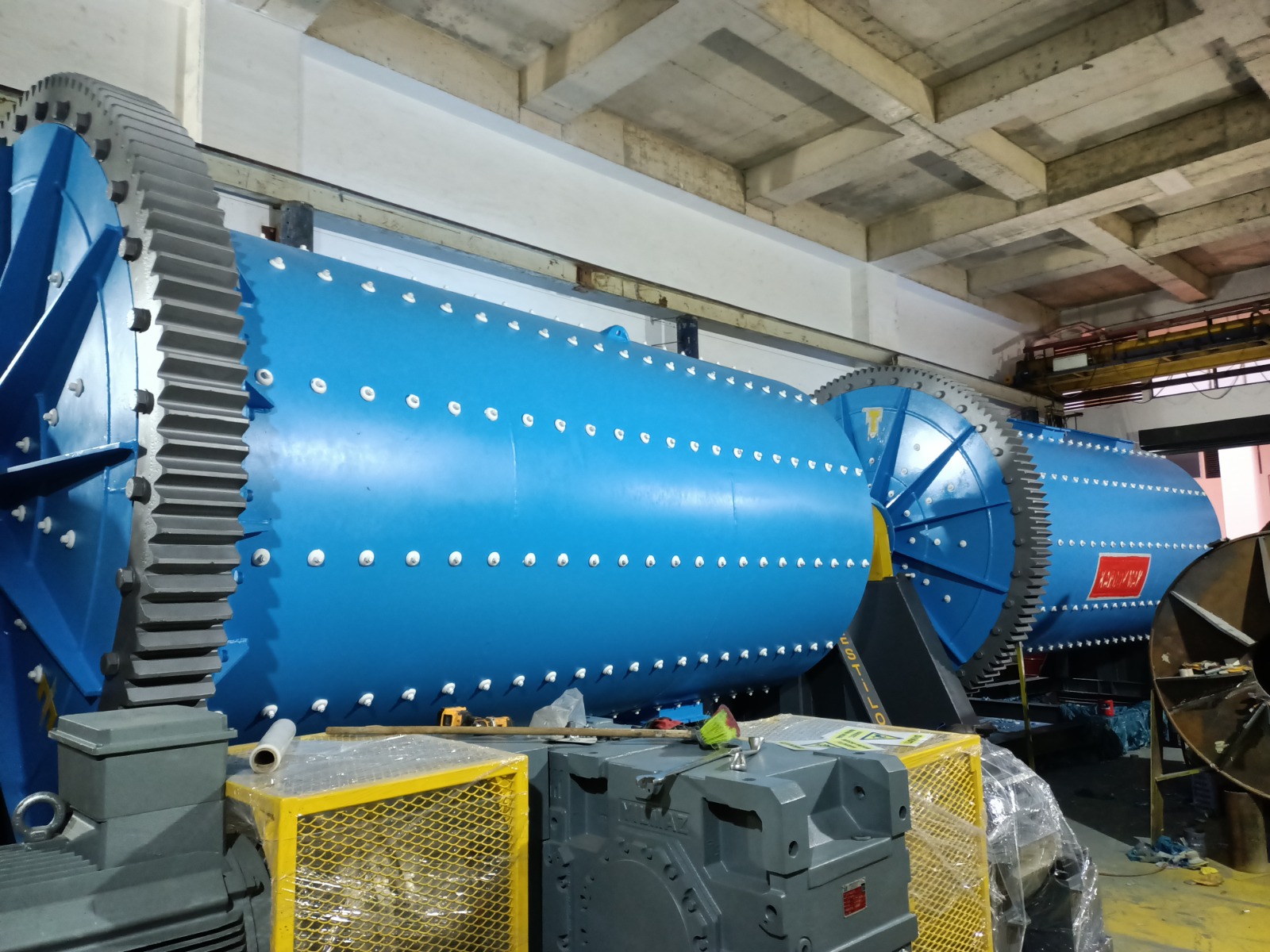
The main difference is the grinding medium: ball mills use balls while rod mills use rods. Rods create more line contact, whereas balls create more point and multi-directional contact, so the correct choice depends on the process target.
Key differences
| Criterion | Ball mill | Rod mill |
|---|---|---|
| Grinding media | Balls in a selected size distribution | Long rods aligned through the shell |
| Dominant contact | Point and multi-directional contact | Line contact and more selective interaction with coarse particles |
| Common circuit duty | Fine grinding and controlled final-product duties | Coarse/intermediate grinding or preparation before ball milling for suitable feeds |
| Product-distribution tendency | Suited to fine-product generation | Can help limit excessive fines in a suitable duty |
| Main test basis | Ball-mill grindability data suited to the material and circuit | Rod-mill grindability data suited to the material and circuit |
| Circuit relationship | Open or classified closed circuit | Open circuit or a stage feeding downstream grinding |
| Decision basis | Target fineness, capacity, energy and classification | Feed top size, target distribution, rod geometry and downstream duty |
How does contact mechanism influence product distribution?
The longitudinal, broadly parallel motion of rods can increase the likelihood that coarse particles enter the contact zones between rods. Balls provide a larger population of point contacts suited to finer grinding duties.
This general behaviour does not guarantee the same outcome for every ore. Texture, breakage characteristics, feed distribution, mill geometry and operating conditions act together.
The limit of the overgrinding claim
A rod mill may help limit excessive fines in a suitable duty, but no product size, efficiency or improvement percentage can be promised without representative testwork.
Difference in circuit duty
A rod mill can be evaluated for producing a controlled intermediate product or preparing feed for a downstream ball mill. The ball mill is commonly placed later to produce a finer target product.
Series operation
A rod–ball arrangement is not the only valid flowsheet. Crushing, classification and downstream requirements must be compared with alternative circuit structures.
Selection approach
- Define the target particle-size distribution and downstream duty
- Verify feed top size and distribution
- Identify suitable grindability and abrasion testwork
- Define open/closed circuit and classification duty
- Evaluate excessive-fines risk against product quality
- Compare rod/ball consumption, maintenance and availability
- Model energy and material flow across the complete line
This comparison supports pre-selection; final diameter, length, power and capacity require test data and supplier engineering.