
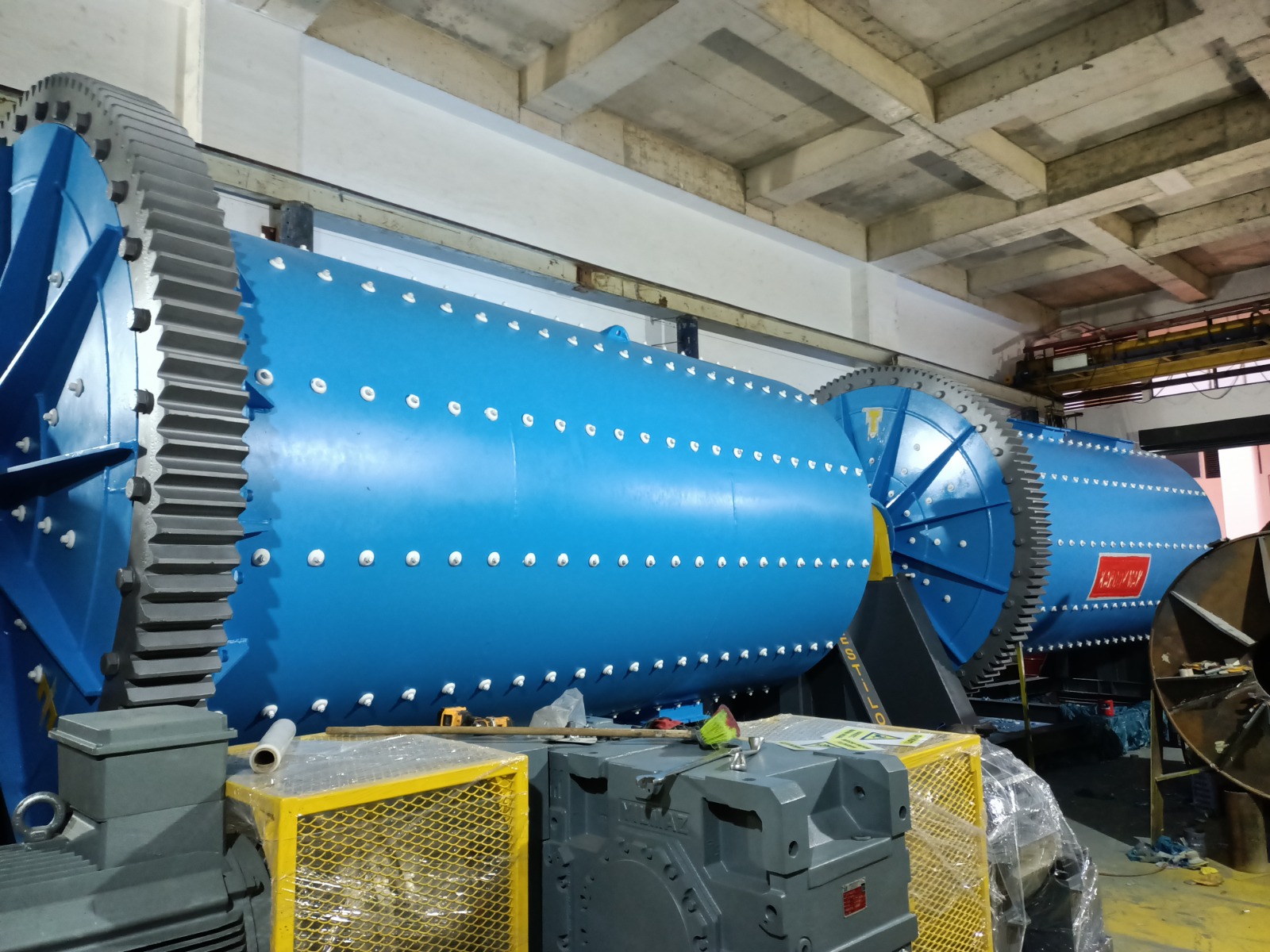
Ball-mill capacity is established by evaluating grindability, F80 feed size, P80 product target, design throughput, operating duty, mill geometry and classification circuit together. Motor power alone does not validate capacity.
What determines ball-mill capacity?
Sizing is more than matching a tonnes-per-hour target to a machine table. The same throughput can require different specific energy and circuit arrangements when ore, feed distribution or product fineness changes.
Material and ore properties
Hardness alone is not a complete description. Breakage behaviour, density, abrasiveness, moisture and feed variability all require review.
Design throughput
Design throughput is the process flow intended for stable operation. It should not be confused with a momentary peak value.
What do F80 and P80 mean?
F80 is the characteristic size through which 80% by mass of the mill feed passes; P80 is the corresponding 80% passing size of the product. Micrometres are commonly used and the sampling and measurement basis must be stated.
F80 and P80 are 80% passing points on cumulative distributions. They should not be confused with d50, d90 or d97 product descriptors.
Feed distribution
One F80 value does not describe the complete feed. The coarse tail, agglomeration and variability can also affect equipment and circuit behaviour.
Product target
P80 must be defined together with product-quality criteria and downstream duties. A smaller P80 cannot be assumed at unchanged throughput.
Bond Work Index and the energy approach
Bond Work Index (Wi) is a comparative measure of resistance to grinding under a standardized laboratory test. A generic handbook value is not a substitute for representative sampling and an appropriate test.
Bond's 1961 Third Theory relationship is W = Wi × (10/√P80 − 10/√F80). In the original form, W is specific work input in kWh per short ton, Wi uses the same energy-per-mass basis, and F80 and P80 are in micrometres.
Variables and limits
- W: comparative specific work for the stated size reduction
- Wi: work index from the appropriate Bond test
- F80: 80% passing feed size, µm
- P80: 80% passing product size, µm
- The unit and test basis must remain consistent
Why this is not final motor power
The equation is an energy-evaluation basis; it does not by itself resolve mechanical losses, circuit efficiency, classification, scale-up or service factors. Final drive and equipment selection use the complete process dataset.
Source basis: F. C. Bond, Crushing and Grinding Calculations, 1961. The relationship is not a production guarantee or a completed mill design.
Circuit, geometry and operating effects
Mill diameter and effective length, filling, liner profile, speed, feed and discharge arrangement interact with capacity. In closed circuit, classification efficiency and circulating load change how much material returns to the mill.
Wet or dry process
Fluid environment, material transport, classification method and downstream requirements differ, so wet and dry circuits are not sized with identical assumptions.
The motor-power misconception
A larger motor does not correct unsuitable feed or classification conditions. How power is transferred to the charge and converted into the target product matters as much as installed power.
Inputs required for sizing
| Input | Engineering role |
|---|---|
| Material and representative sample | Grinding and wear behaviour |
| Design throughput | Steady process duty |
| F80 | Feed particle size |
| P80 and product distribution | Product target |
| Bond Work Index | Comparative energy evaluation |
| Moisture and process medium | Wet/dry behaviour |
| Circuit arrangement | Classification and return structure |
| Operating schedule | Duty and availability conditions |
| Site conditions | Layout, auxiliaries and maintenance access |
This table defines design inputs; it does not generate capacity, power or dimensions without verified project data.
How does an engineering review proceed?
- Verify representative samples and size distributions
- Define P80 and product-quality criteria
- Select an appropriate grindability test
- Decide wet/dry and open/closed circuit in process context
- Evaluate mass and energy balance together with classification
- Validate equipment geometry, drive and auxiliary systems
